Pages

Showing posts with label Science With Mr Stock. Show all posts

Monday, 11 November 2019

Earthquakes - Science

Questions I Have About Earthquakes?
A rupture along a fault line
What causes an earthquake?
Earthquakes occur when two or more tectonic plates move against each other generating waves which shake the ground. There are many types of earthquakes but the most dangerous is subduction when the densest plate is being forced down underneath the less dense plate either causing trenches or mountains/volcanoes. If an earthquake is shallow it causes more destruction because it's closer to the surface of the earth.

What is the magnitude of an earthquake and how are they measured?
The magnitude measures the amount of energy released during an earthquake. An Earthquakes magnitude is measured using the Richter Scale which measures from 0 to 10. 10 being the strongest. 0 being the lowest. A magnitude 10 earthquake has never been experienced but the largest earthquake ever recorded was in 1960 in Chile with a magnitude of 9.5. Every time you jump up one number on the Richter scale the energy released is 10 times greater. 

Can you predict earthquakes?
Possibly, but scientists can only identify areas where the earthquake might occur they can't predict the exact time or date it will happen. 

Can humans cause earthquakes?
Possibly, but only small shakes and rumbles in the ground small enough to barely feel it. This happens through hydraulic fracturing. Commonly known as fracking. Fracking is a technique used to access oils and natural gases deep down in the earth crust. Or mining but I will elaborate on fracking. 

How does fracking work?
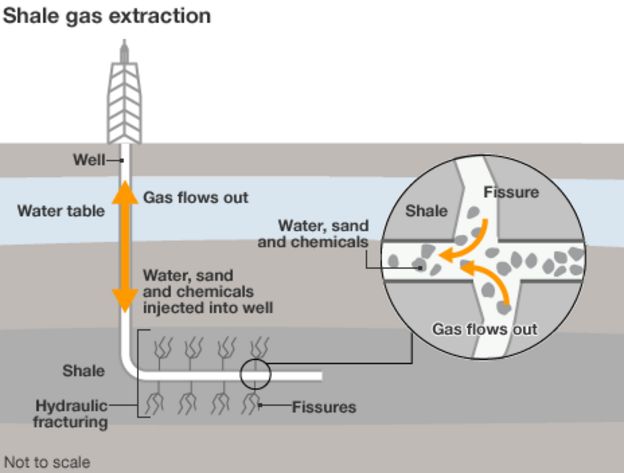
Image result for fracking
Millions of years ago organisms had died and layers were forming on top of them. The intense heat and pressure under the earth's crust caused the organisms to break down into liquid creating oil and naturals gases. The technique of fracking allows the oil and natural gas to be extracted out. 

Fracking works by drilling a wellbore ( really long hole ) into the earth's surface. When the wellbore reaches 2.5km to 3km ( these numbers may vary depending on where the oil and gas is ) in the ground it's at its kick-off point. The wells which surround the interior of the drill is created with steel and cement so they do not burst open due to the pressure of the water. Then the drill turns 90 degrees and starts drilling horizontally for approximately 1.5 km through a compressed shale rock formation ( compressed silt and clay ). Next, a specialized preformatting gun enters and a series of small shots are fired creating holes in the compressed shale rock. These holes are about 1 inch long that bursts from the drill and into the rock layer. After 3 to 4 months of the original drilling, the well is ready for fracking to start. 

Fracking fluid is pumped into the well with an intense amount of pressure which causes the shale rock to crack creating holes. These holes open the way for the oil and natural gas to flow out. In the fracking fluid, clay and sand are added so that the oil and gases can keep flowing even after the pressure is released. 

Where do earthquakes commonly occur?
Earthquakes occur on fault lines in the earth and the edges of plates. But mostly are common near the edge of the plate. Fault lines are cracked sections in the earth where plates are moving in various directions. Faults are caused by sliding and bumping. The worlds biggest earthquake belt is found along the rim of the pacific ocean. Also known as the ring of fire it is where 81 % of all earthquakes happen. This ring of fire exists along plate boundaries where most of the subducting happen. 
Image result for the ring of fire


What are body waves and surface waves?
Earthquakes produce three types of seismic waves p waves, s waves and surface waves, however, they all move through the earth differently. Surface waves are waves that travel across the surface of the earth whereas the body waves travel through the interior or the "body" of the earth. There are two types of surface waves rally waves and love waves. Rally waves are when the ground moves up and down whereas love waves are when the ground moves side to side ( left to right ). Body waves are of two types primary waves and secondary waves. On average, P waves move faster than s waves. P waves are the first to reach any location after an earthquake happens. Primary waves can travel through solids, gases and liquids. However, S waves are the second to arrive at the location after an earthquake even though they start at the same time as primary waves. Secondary waves can travel through solids but not through liquids or gases. S waves travel at half the time of P waves. 

What is an aftershock?
An aftershock is a smaller earthquake following the shock of a large earthquake. Aftershocks don't mean a larger earthquake is about to hit. It means that the plates are slightly adjusting. An aftershock may occur hours or days after the major earthquake. 

Friday, 18 October 2019

Marshmallow Catapult - Physics

Marshmallow Catapult

Aim: To construct marshmallow catapults and record its height and distance.

Equipment: Marshmallows (1 Packet), Rubber Band, Plastic Spoon, Wooden Skewers  ( 7 ) & Tape.

Method:
1. Place three marshmallows in a triangle, them connect them with skewers. 

2. Take a skewer and stick it onto the top of the marshmallow. 

3. Bring the tops of all three skewers and stick them together with one marshmallow.

4. Take a spoon to another skewer.

5. Stick this skewer into one of the marshmallows below the skewer already placed.

6. Take the rubber band and wind around spoon and then loop end of the rubber band around the marshmallow and bringing it underneath the marshmallow {should not be on marshmallow}.

Results:
Unfortunately, we were not able to measure the height of the flying marshmallows but did get the distance. 

Discussion:

Forces Behind The Experiment:
Before we even applied any force or energy on to our catapult, there were already forces acting on the object. This was support and weight force. These forces were keeping the catapult at an upright position, the forces were balanced. This meant that the object was motionless. As we pulled down the catapult kinetic energy was changed into elastic potential energy. When the spoon was pulled down it also gained elastic potential and as we released it converted the energy into motion. As it flew through the air it gained gravitational potential energy. The marshmallow gained as much gravitational potential energy until it stopped at a height which it could no longer go higher and started falling down again, which then was converted into kinetic energy as it fell back down again.

Definitions:
Support Force: is a force that balances the weight of an object.
Weight Force: Weight force is the force of gravity on an object.
Kinetic Energy: When an object is in motion kinetic energy is created.
Elastic Potential Energy: An elastic which can store energy and convert it into motion. 
Gravitational Potential Energy: Energy an object has when off the ground.

Structures:
We found out that different catapults gave us different results. We had three catapults:
Catapult 1: Was the spoon catapult. 
Catapult 2: Was the catapult with the purple bottle cap.
Catapult 3: Was the catapult with the small metal cap. 


These are some results involving distances from our experiment:
Catapult 1


Catapult 2


Catapult 3

Small
Big

Small
Big

Small
Big
0.5
0.8

4.1
3

2.2
0.3
2
0.9

4.2
5

2.5
1
2.5
0.9

4.4
5.7

3
1.8
3.5
1.1

5.8
5.7

3
2
3.8
1.4

6.3
6.9

3.1
2.3
4.6


6.5
6

3.4

4.9


8.3


5.8


5.8


5.8


4


6.3


6.4


As we can see catapult two has the longest small marshmallow throw (8.3m). And, catapult two has the longest big marshmallow throw (6.9m). This is becasue of its structure, catapult two has a bigger structure and more elasticity. This means it's able to bend back further building up more elastic potential to fling further. The more it bends back the further it goes. We can also see that catapult three is not able to fling marshmallows further than 4m because of its size. Catapult three is 2x smaller than catapult two which means it's not able to bend back as much and gain as much elastic potential energy. When bending catapult three we are bending the wood, which is not ideal as it is stiffer. 
Catapult one is the design we made, it has a spoon as the material we bend back, this means it is bendier. It is quite small than means it does not bend all the way back. In conclusion, without a doubt, the best catapult would be catapult two.

Calculating Gravitational Potential Energy:

Thursday, 22 August 2019

Lemon Battery Experiment - Science

🍊 Lemon & Orange Battery 🍋

Aim: I want to investigate which fruit works better ( Lemon Battery or Orange Battery )

Image result for lemon battery experimentEquipment: Orange, Lemon, Copper Nail, Zinc Nail, Voltmeter, Switch, 3 Alligator Clips, Light bulb.

Method: 
1. Gather all the equipment.
2. Take a lemon or orange and roll it. 
( Without Breaking The Fruit )
3. The aim is to soften the fruit so it releases citrus juice. 
4. Then attach the nails in the lemon, approximately 4 cm apart.
5. When attaching the nails in the fruit be very careful, making sure it won't break.
6. Then clip the alligator clips between the nails and the others from the lemon to the bulb.
7. Observe Results. 

Results: 
Evaluation
During the experiment, many things went wrong. The lemon and orange battery didn't light up the 9 volt light bulb. So we decided 9 volts is too high. We changed the bulb to a led light bulb which takes approximately 2 to 3 volts. Our voltmeter only read 0.7 volts the highest. Copper and Zinc metal should only produce 1 volt. There are many reasons why the LED wouldn't have light up:
1. A layer of oxides ( Rust ) was stopping the conduction of electricity. Which is why it's a good idea to clean the metal. 
2. The lemon and orange didn't have enough citric acid. The more acidic a fruit is the more electricity it will generate.
3. Using ripe lemons.
If you were to do this experiment don't use ripe or under-ripe lemons, this is because they don't contain as much juice. Whereas overripe lemons have juice which helps electricity flow.  Clean off the rust properly, otherwise as it says above it will stop conduction of electricity. Also, check that all the wires are working. 

Discussion:
For our lemon and orange experiment, we cut a slit in the lemon and attached copper and zinc nails. Then we connected the zinc metal and copper metal together with an alligator clip. This acted as a conductor, which allowed electricity to flow. We measured the energy the current was carrying with a voltmeter. 

First, we built a circuit. A circuit is a path which the electrons can flow through. For a circuit to be complete charge must be flowing. For a lemon battery to work, you need to have two electrodes and one electrolyte. In this case, we have our to metals (Zn & Cu) as our electrodes and the lemon as our electrolyte. An electrode is where the charges gather, Cu and Zn. An electrolyte is ions in a solution, citric acid. An electrode which wants more electrons is called a cathode and the one which gives up electrons is called the anode.

The electrons are flowing anti-clockwise from zinc to copper through the wire. Zinc and copper both want to lose electrons but zinc is more reactive. Our anode (Zn) has two electrons in its outer shell and wants to lose them. We would say zinc has a higher electronegativity, meaning it has a stronger desire for electrons than copper. By losing these two electrons it now becomes Zn²⁺. The electrons are now going to leave zinc and go to copper, left on zinc are positive charges. This is similar to copper the electrons are going to leave copper and go to zinc, leaving copper with negatives charges. After zinc has lost its electrons it will move freely around the lemon. Inside the lemon is citric acid. Citric acid will dissociate (break apart) into acid, H⁺ ions and citrate. The electrolyte has a negative and positive charge, citrate - and hydrogen +. Citrate is going to go to zinc because positives and negatives attract. Same goes for Hydrogen it will go to copper.

The reaction happening is a redox reaction. Reduction Oxidation. Reduction means when charges reduce or decrease and oxidation means when charges increase. As we know Zn went from having no charge to having 2⁺. This is oxidation. The hydrogen went from 2H to H₂ ( Hydrogen gas ) and has become neutral. Reduction. This is definitely the reaction that occurred because of one of my peers noticed bubbles, which indicates a sign on hydrogen gas.

Thursday, 4 July 2019

Testing For Hydrogen Gas - Chemistry

Link
Testing For Hydrogen


AimReacting metal with acid to create hydrogen gas.

Equipment: Test Tube, Boiling Tube, Wooden Splint, Hydrochloric Acid, Retort Stand, Clamp, Magnesium 2M & Safety Glasses.

Method:
1. Attach the boiling tube to the retort stand and place the boiling upside down.

2. Add your sample of metal to your test tube, pour 2-4 ml of acid into the test tube. Shake it gently.

3. Keep shaking/swirling the boiling tube ( gently ) and bubbles will appear. Do this for a few minutes, until the metal is dissolved. Wait for it to fill with gas. 

4. When you think the tube is full with gas carefully remove the test tube.

5. Light a wooden splint and put it at the opening of the boiling tube. Observe.


Results:


Evaluation: 
During the experiment, my group had to change the equipment because they were of no use. We changed the conical flask to a boiling tube because the hydrogen gas kept escaping out of the holes. I recommend using these changes.

Discussion:

Balanced Equation:
Magnesium reacts with hydrochloric acid to produce magnesium chloride and hydrogen gas. If hydrogen gas is present the wooden splint will go out with a loud pop noise.
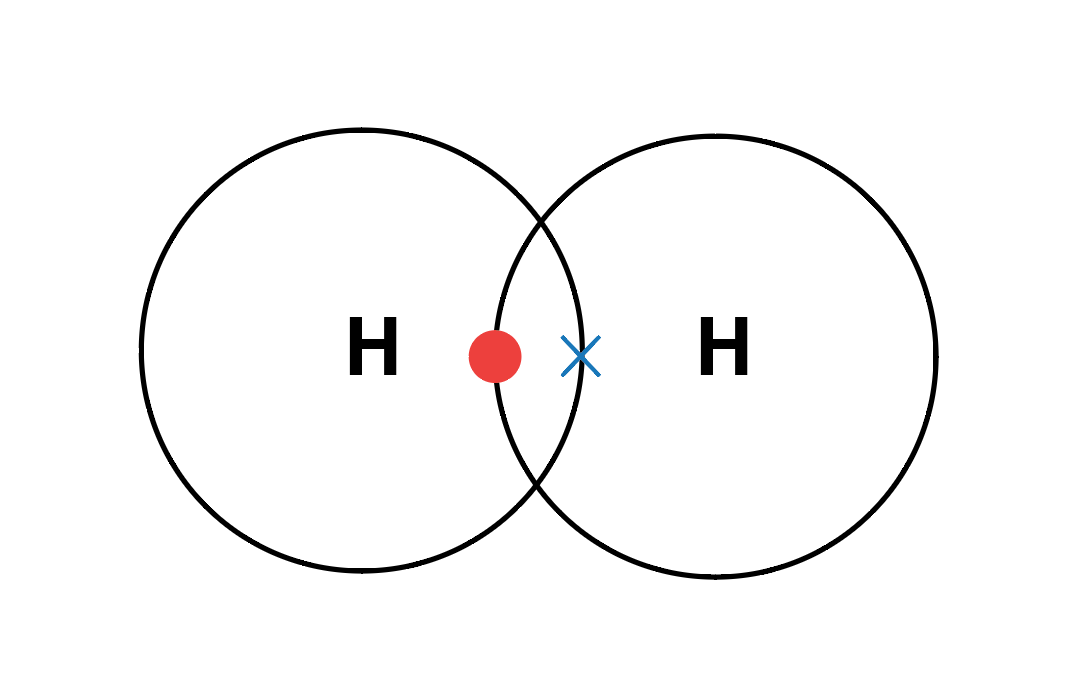
Magnesium has an electron configuration of 2, 8, 2 and wants to lose two electrons to become stable. So Magnesium is now going to become Mg²⁺. Both Hydrogens are going to accept one electron each and form a covalent* bond. Because Hydrogen can only have two in its shell, both hydrogen is going to share both electrons.
Image result for hydrogen covalent bonding
Chlorine has an electron configuration of  2, 8, 7 and is very electronegative. Electronegative meaning it loves electrons. Chlorine is then going to steal an electron from hydrogen, and then it's going to turn into chloride. Magnesium has a positive charge and chloride has a negative charge and they have an electrovalent bond. 

Covalent Bonds: Bond which involves sharing electrons.